
I chose St. Ermin’s Hotel which is part of the Autograph Collection with Marriott. I used points to book the hotel (work travel perks sometimes help fund my travel obsession) and chose it based on the location. The hotel is set back off the street and I walked through the tree-lined courtyard to the lobby. It was quickly apparent that this hotel has history. The hotel website gives much more detail on the history and I have tried to capture the essence of it’s historical significance in a more condensed version.
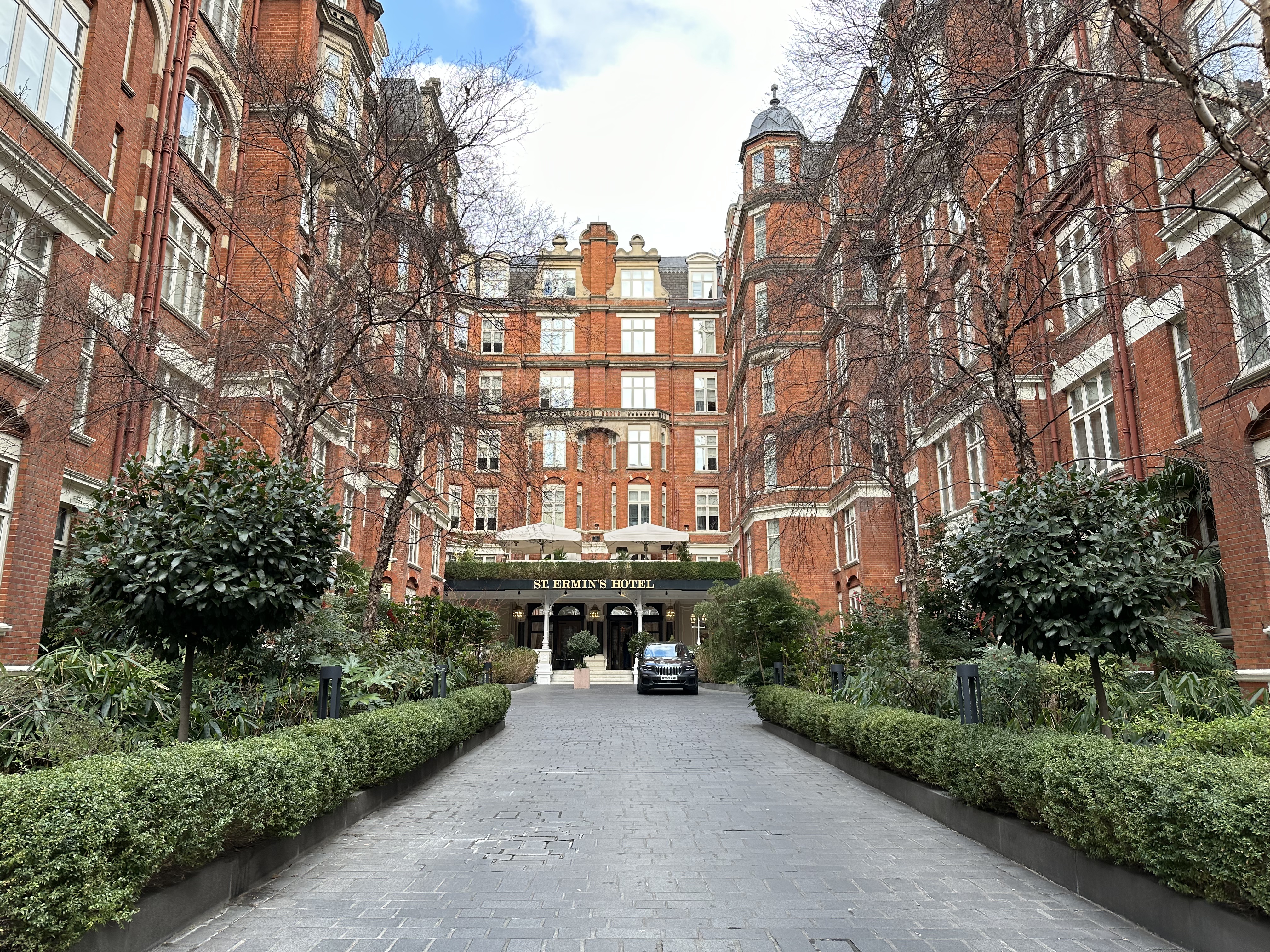
St. Ermin’s Hotel is built on the site of a 15th century chapel dedicated to St. Ermin (a derivation of St. Armel). St. Ermin’s Mansions, the building that forms the basis of the now hotel, were created in 1889 by E.T. Hall during an expansion of Westminster. One decade later, the mansion blocks were converted into a hotel and the new owners employed J.P. Briggs, a famous Victorian theatre designer, to redesign the interiors. Briggs created a dramatic interior of intricate plasterwork that is still evident today.
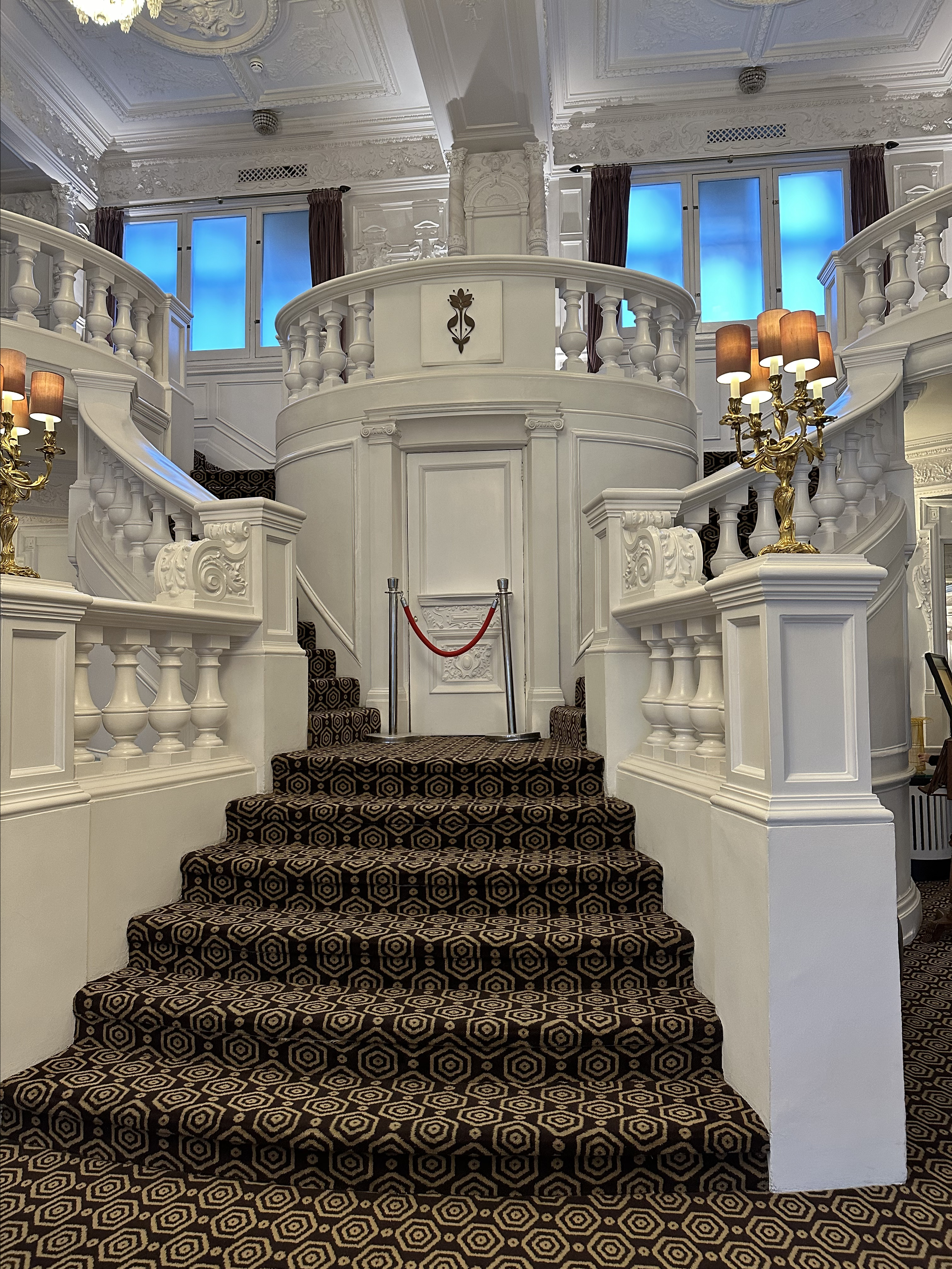
In 1940, Winston Churchill used the hotel to hold a meeting with a group that would ultimately become the Special Operations Executive (SOE), also know as Churchill’s Secret Army. Ultimately an entire floor of St. Ermin’s was taken over as the headquarters for Churchill’s Army during WWII and MI6 were stationed a few floors above. Churchill, a man apparently known for his fondness of champagne, would often enjoy a glass of his favorite in the Caxton Bar. You can visit the Caxton Bar to enjoy a glass of champagne or something a little stronger, if you like. The bar offers specialty cocktails with nods to the history of the hotel and bar.
The hotel has an association with British history beyond the Second World War. Guy Burgess, a double agent and defector, is rumored to have used the Caxton Bar to meet his Russian contacts and hand over secret government documents. Aspects of this colorful history are still visible in the hotel through an original SOE silk that was printed with secret coded messages and a display of field equipment. The lobby also houses several artifacts of historical context including a Division Bell. These bells were installed in the Westminster Bubble, an area within an eight minute walk to the Houses of Parliament, to call MPs to a vote. Though the tradition of calling MPs back via the Division Bell has since discontinued, the bell is authentic in every detail.
St. Ermin’s also makes good use of its rooftops with bees producing honey and a kitchen garden providing fresh produce. . Visiting in February means there wasn’t much activity at the Bee Terrace but it is easy to envision the 350,000+ bees going about their hive activity and producing honey. There are hives as well as a ‘Bee & Bee Hotel’ which has lodging for other types of bees and helpful insects. The rooftop is home to the kitchen garden which provides fruit and vegetables which, like the honey, are used in the kitchens.
I arrived at the hotel at approximately 9am local time and had some time before my room was available. Sofia from the front desk directed me to the washrooms to freshen up and change for some exploring and the bellmen stored my luggage for me. I was soon off to explore!
 Travel with Fleming